- A tagine is a clay pot with a tall conical lid, and the name of the dish cooked inside it.
- The lid sends steam back down into the food, so it cooks slowly in its own juices.
- Classic pairings mix sweet and savoury: lamb with prunes, chicken with preserved lemon and olives.
- At Dada, tagines start at €23.95 and are served in the pot they cook in.
Ask for a tagine in Morocco and you might be talking about a pot or a meal. The word means both. A tagine is a shallow clay dish with a tall, pointed lid, and it is also whatever slow-cooked stew comes out of it. Once you understand the pot, you understand why the food tastes the way it does.
How the conical lid works
The shape is not decoration. As the tagine cooks over a gentle heat, steam rises into the cone, cools against the clay and runs back down into the food. Very little moisture escapes, so meat and vegetables braise in their own juices for hours without drying out. The result is tender, concentrated and deeply aromatic.
Traditionally a tagine sits over charcoal, and the slow, steady heat matters as much as the recipe. It is the opposite of fast food, and it is the reason a good tagine is worth waiting for.
The flavours to expect
Moroccan cooking loves to balance sweet and savoury. You will often find fruit and nuts next to meat, and bright, salty notes cutting through rich sauces.
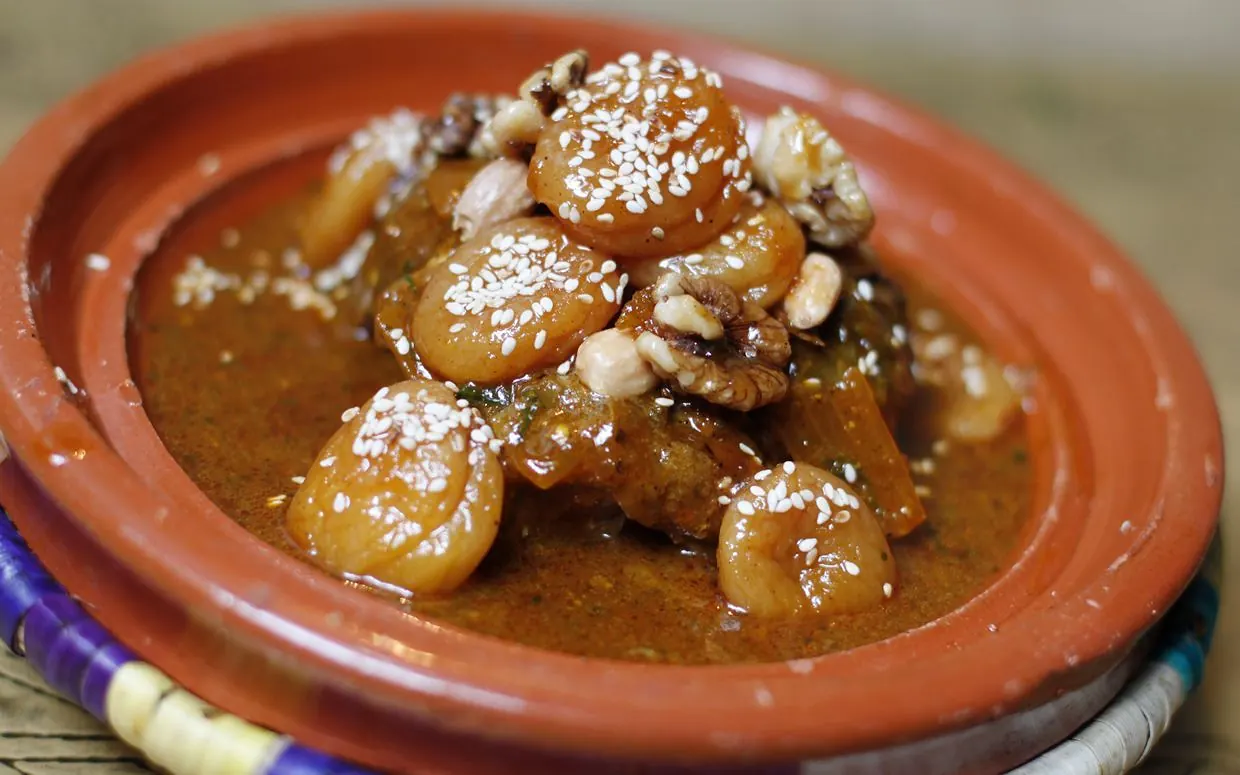
- Lamb with prunes, almonds and cinnamon, a festive classic.
- Chicken with preserved lemon and olives, sharp, salty and fragrant.
- Fish with ginger, tomatoes and peppers, lighter and fresher.
- Seasonal vegetables with preserved lemon, proof that a tagine does not need meat at all.
Two ingredients do a lot of the work. Ras el hanout is a spice blend whose name means "head of the shop", the best a spice merchant has to offer. Every family and every shop has its own version. Preserved lemons are cured in salt until the skin softens, and they add a bright, almost floral sourness that is impossible to copy with fresh lemon.
Tagine or couscous?
They are close cousins on the Moroccan table. A tagine is a braise cooked under that conical lid. Couscous is fine semolina, steamed until light, and usually served with vegetables, meat and a rich bouillon poured over the top. If you cannot decide, order one of each and share. Nobody will mind.
How to eat a tagine
In Morocco, bread is often the cutlery, torn and used to scoop up the sauce. At Dada we bring your tagine to the table in its pot and lift the lid in front of you, so the steam and the scent arrive first. Add a side of bread or couscous with olive oil to catch every drop of sauce.
Tagines on our menu
Our tagines are slowly cooked in clay, and we only use spring lamb, with all our meat 100% prime Irish certified.
- Lamb tagine with prunes, walnuts, almonds and cinnamon, €27.95
- Lamb tagine with roasted carrots, peas and ras el hanout, €27.95
- Braised chicken fillet with preserved lemon, Moorish olives, saffron and potatoes, €25.95
- Chicken supreme with saffron caramelised pears and roasted almonds, €25.95
- Hake fillet with ginger, spring onions, tomatoes and red peppers, €27.95
- Seasonal vegetable tagine with preserved lemon, €23.95, vegan and gluten free
See them all on our dinner menu.
Quick answers
What is a tagine?
A tagine is a North African clay cooking pot with a conical lid, and also the name of the slow-cooked dish made in it.
Why does a tagine have a pointed lid?
Steam rises into the cone, cools, and runs back down into the food. That keeps everything moist while it cooks slowly over a low heat.
Is a tagine spicy?
Not usually. Tagines are fragrant rather than hot. At Dada our food is gently spiced, and you can ask for house harissa if you want more heat.